Friday, April 17, 2020

Learning Plan Apr. 20-24 (Week 4)

Learning Plan Apr. 20-24
Math 

Monday 

I can use the array strategy to solve multiplication equations. 

This is a quick review of arrays.  Choose your own adventure! If you need review, choose #1.  If your comfortable and confident with arrays already, choose #2.

Array: an arrangement of objects, pictures, or numbers in columns and rows. This strategy is useful when asked to find the solution to either a multiplication or division question.

#1 - Review: Arrays for 1 digit by 1 digit multiplication: Watch the video for a review and explore possibilities of using arrays with multiplication. https://www.khanacademy.org/math/arithmetic/arith-review-multiply-divide/arith-review-mult-intro/v/multiplication-intro
Task: Please take a moment and enjoy the learning game called ‘How Close to 100.” This activity will help you build more of an understanding of an array. You can print the handout directly from the website or you can make your own game board (you will then have the flexibility to make it as small or big as you please)


OR

#2 - Challenge: An array has 36 squares. How many rows and columns could there be? Find as many solutions as you can. Show your understanding through diagrams and/or words.

Tuesday 

I can use the array strategy to solve multiplication equations.

Problem: Jenny planted a garden with 6 different types of vegetables. She uses one row for each different vegetable (i.e. carrots, beets, lettuce, cucumber, peas, and spinach). For each vegetable, she plants 80 seeds spread out across the row. 

  1. Draw a diagram of Jenny’s garden. How many plants in each row? How many in each column? Is it an efficient strategy to draw each individual seed? Is there a more efficient model you could draw? (hint: think place value)
  2. Write a multiplication sentence (equation) and solve it to show how many total vegetable seeds Jenny planted. 

  1. Write a corresponding (matching) division sentence (equation). Explain your division sentence in your own words. For example, knowing the total number of vegetable seeds Jenny planted, what equation could show the calculation for how many rows? And another for how many columns?

Wednesday

I can use arrays to solve 1-digit x 2-digit multiplication questions. 

Watch the attached video to see a great way to use an array for 1-digit by 2-digit multiplication problems. This is far more efficient than drawing out each individual square, isn’t it? 


Arrays can be used to explore calculations such as 13 x 5 where the array can be split into useful chunks such as 10 and 3. This way, you can use known number facts to work out calculations for larger numbers.

For example: 13 x 5 = (10 x 5) + (3 x 5).


Part 1: For each of the following multiplication sentences (equations), draw the array and solve by using the distributive property (refer to the example). Choose 4 of these equations based on your comfort level with this concept (they increase with difficulty). 

  • 12x2= 
  • 3x14=
  • 24x3=
  • 16x2=
  • 54x8=
  • 5x47=
  • 82x6=
  • 4x77=
  • 9x99=

Part 2: Can you write the corresponding division equations for 2 of the above multiplication equations?

Thursday

Here is another way to represent arrays as a further shortcut when working with larger numbers. 

Video (start at 4:13): Matrix array strategy for larger numbers

Pretty cool, right? 

Give it a try. Choose 4 of the following equations to test it out (they are the same as the equations used yesterday, so you can check your work!). 


  • 12x2= 
  • 3x14=
  • 24x3=
  • 16x2=
  • 54x8=
  • 5x47=
  • 82x6=
  • 4x77=
  • 9x99=

Which array method do you prefer? Why?

Friday
I can use related multiplication skills when solving division equations.
After learning more about how to preserve the planet on Earth Day, Bob’s family decided to start using an outside compost bin. His family composted 49 kg of scraps in 7 weeks.

  1. How many kilograms of scraps did they compost each week? Show your work using diagrams/manipulatives. 
  2. How many weeks would it take them to compost 42kg if they composted 6kg each week.
  3. Do you notice a connection between the two questions above? 
  4. How can multiplication help you in finding the solution to a division question?

Literacy
In order to organize the tasks better, we have labeled them by the days of the week.  It doesn't matter what order you complete them in. If you’d like to go out of order just “turn in” your work for the day you’ve completed.

Monday

Responding to a Picture

  • I can describe what I see
  • I can pay attention to details 
  • I can share my understanding about a given image

Task 1:
Use the Image “The Jar Wizard” and the questions to practice different ways to understand an image by using the questions provided. (See attachment for image)  Answer the questions in complete sentences or a paragraph.

  1. Who do you think this is?
  2. Why is he carrying all of those jars? What’s inside them? Why are they attached to his clothing? Couldn’t he just carry them in a bag?
  3. Why is he wearing this clothing?
  4. Is he going to open the blue jar? Why?
  5. Why is his other fist clenched?
  6. What does his body language tell you about his thoughts and feelings?
  7. Choose 3 words to describe this character. Justify your choices and explain why your words are better than anyone else’s!

Picture from:  https://www.onceuponapicture.co.uk/the-collections/the-character-collection



Tuesday

Responding to Non Fiction

  • I can read non fiction with understanding
  • I can share my understanding using complete sentences
  • I can use details from a video to support my ideas


Tuesday

Introduction to Light and Shadows

□  I can identify a wide range of sources of light, including the Sun, various forms of electric lights, and flames.)

□  I can organize my ideas  and information using appropriate categories


Part 1: Find 5 or more different sources of light that have been created by humans and 2 sources of light that are natural. 

Part 2:
  1. Make a visual journal page with the title “Light and Shadow”
  2. Draw a line down the middle of the page. Title 1 side “Sources of Light” and the other “What are they used for?”
  3. Draw a picture of the objects you find under “Sources of Light”. Make sure you label your picture.
  4. Beside each object, explain what these lights are used for under the column “What are they used for?” (for example:Source: microwave light.  Uses: to see the food better to make sure it is cooked.)


Wednesday
Writing Prompt 
Choose one to write about.
  • I can use details to tell the who, what, when, where in my writing
  • I can start with a catchy lead sentence to grab the reader’s attention
  • I can describe people, places and things using a variety of words and phrases in complete sentences
  • I can tell things in order (beginning, middle, end)
  • I can edit my work so it makes sense to the reader (read it out loud to yourself)
    • Capital letters
    • Ordinary words
    • Punctuation
    • Spelling

Instructions:
Choose one of the prompts below, write for about 20 minutes (set a timer if you like). Read your writing to your parent/older sibling or out loud to yourself and make any edits needed before you turn in your work.

CHECK: Does it make sense???
Write about a time you felt really happy. What happened? What made you feel happy?
OR 
Imagine that dogs take over the world. What do you think they would make humans do?


Thursday

Word Work


⭙ I can identify onomatopoeia in the story “The Great Kapok Tree.”
⭙ I can find and record onomatopoeia words in other readings.

Onomatopoeia is when authors use words that sound like the action or object they are naming. An author might use the word “buzz” to describe the sound a mosquito or bee makes. The word “crunch” might be used to describe the sound of someone walking in the snow or someone eating a potato chip.
  1. Watch the “Onomatopoeia” movie https://www.youtube.com/watch?v=f1b5kCvVBo8 

  1. Re-read the story “The Great Kapok Tree.”  Lynn Cherry (the author) used onomatopoeia words to make the story come to life. Try to identify as many onomatopoeia words as you can and record them in your journal. You will notice that the author used many sound words that the animals make (ie. squawking birds or howling monkeys.) 
  2. In your journal, put the title “Onomatopoeia.”
  3. Draw a picture beside each word and put the onomatopoeia word in a speech bubble. You should be able to identify at least 7 onomatopoeia words in this story. 
  4. Challenge:  During the week add to this page by adding more onomatopoeia words that you can identify in other books that you read. Add more words that you already know. How many words can you add to your page?

Friday

Letter to the teacher

  • I can respond personally to an idea
  • I can share my understanding using complete sentences
  • I can select pictures that enhance my writing


Would you rather give up eating sweets or give up eating fast food?

Think about your choice:
  • Why did you choose that one?
  • Do you think this would be difficult for you to do or easy?  Why?
  • What are the benefits of your choice? What are the challenges?
Write a letter to your teacher sharing your ideas.  Include a picture that relates to your choice. It can be a photo of a hand drawn picture, a photo you took or a picture you found online (be sure to cite the source).


Personal Challenge (optional - NOT assessed) 

At the beginning of each week, please have a conversation with your child about setting an attainable goal for the week. On top of setting the goal, please have a conversation about how you and your child will know if the goal has been achieved. During some weeks, the goal may have a specific direction while other weeks the goal may be student driven.   

Earth Day is on Wednesday, April 22nd. This year will actually mark 50 years of Earth Day. Take a moment to brainstorm with your family on what small acts (indoor and outdoor) you can do to pay homage to the earth. For example, will you take shorter showers, unplug your appliances when they are not in use, or turn off lights when not in a room. The possibilities are endless. 

Monday, April 13, 2020

Learning plan Apr. 14-17 (Week 3 tasks)

Hello room 5 families,

  Here are the learning tasks for Week 3.  Remember, posting in the blog can modify the format and look very overwhelming.  Students are encouraged to view the assignments directly in Google Classroom whenever possible.

Learning Plan for Grade 4 - April 13-17

Math

Tuesday

**This is a review for many of us.  If you feel very comfortable with the repeated addition strategy already you may skip #1-5 and go straight to the challenge questions at the bottom.


I can use repeated addition to show my understanding of multiplication questions.

Watch the following video on repeated addition prior to completing the learning activities.


Use manipulatives or drawings to help you solve these problems.  Record the matching equation (multiplication sentence) and solution. 

Question: Maple Ridge School is collecting and donating used bicycles for children who may not have one to enjoy in the summer. The pictograph shows the number of bikes collected by classrooms.


Bike Donations by Classroom

Room 1
X X X
Room 2
X X X X X
Room 3
X X X X 
Room 4
X X X X X X X X
Room 5
X X X X X X X X X

Each X means 5 bikes.

  1. There are 8 wheels for Room 4. Each wheel represents 5 bikes. Can you use repeated addition to show 8 groups of 5 bikes? Write an addition equation and a multiplication equation to show the number of bikes donated by Room 4.
  2. How do you know you can write 9 x 5 = ? to represent the number of bikes donated by Room 5? Complete the multiplication equation. Explain your solution.
  3. Write and complete addition and multiplication equations to represent Room 1, 2 and 3.
  4. How are the above addition equations and multiplication equations alike? How are they different?
  5. What number patterns do you notice when you skip count by 5s?


**Challenge Questions

Question: Maple Ridge School is collecting and donating used bicycles for children who may not have one to enjoy in the summer. The pictograph shows the number of bikes collected by classrooms.


Bike Donations by Classroom

Room 1
X X X
Room 2
X X X X X
Room 3
X X X X 
Room 4
X X X X X X X X
Room 5
X X X X X X X X X

Each X means 50 bikes.

  1. Each wheel (X) represents 50 bikes.  Write and solve a multiplication equation to show the number of bikes donated by each room.  If you solved it using mental math, record your thinking.
  2. Write and solve a new question about this pictograph.  You may change the value of the “X” or keep it the same.

Wednesday

**This is a review for many of us.  If you feel very comfortable with the repeated addition strategy already you may skip #1-3 and go straight to the challenge question at the bottom.


I can use repeated addition to show my understanding of multiplication questions.

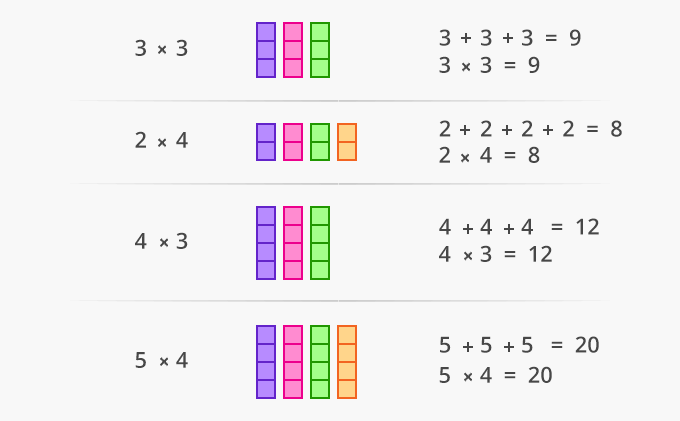
Review the example chart below for the connection between repeated addition and multiplication.  

1.What connection can you make between the first and second numbers in the multiplication sentence and the block drawings?

 2.Do you notice an error in the table below? If so, please correct the statement that is incorrect and provide an explanation of how you made it correct.


repeated addition


3. Using a pair of dice OR a deck of cards, roll/flip two cards over to determine which numbers you will be working with. Complete the chart below using the example above for assistance.

Multiplication Sentence
Drawing/Manipulatives
Repeated Addition Sentence
For Example:
3 x 2
X         X
X         X
X         X
3 + 3 = 6
3 x 2 = 6


**Challenge Question

4. Using a pair of dice OR a deck of cards, roll/flip 3 cards over to determine which numbers you will be working with. Complete the chart below using the example above for assistance.

Multiplication Sentence
Estimate (show your work) 
My solution (using my personal strategy)
For Example:
36 x 2


Thursday

**This is a review for many of us.  If you feel very comfortable with the repeated addition strategy already you may skip #1-5 and go straight to the challenge question at the bottom.

 I can use repeated addition to solve 1-digit x 2-digit multiplication questions.


Jacob started a donation drive for his local food bank. He asked a number of his friends and family to also donate. Each person donated $4 to the cause. Solve each question below using repeated addition and show your work. 
  1. Day One: Jacob and 6 family members each donated $4. How many dollars ($) were donated by Jacob and his family members?
  2. Day Two: 32 of his friends made $4 donations. How many dollars were donated by Jacob’s friends? 
  3. Day Three: Jacob asked his friends and family to donate more. Half of his family and half of his friends each made another $4 donation. How many additional dollars were donated today?
  4. How many dollars were donated in total over the 3 days by Jacob and his friends and family?
  5. Reflect on which numbers you chose to add. Did you find it more efficient to add the smaller or larger numbers? Explain. 


**Challenge Question
Choose either choice 1 or choice 2.  Do your best to find all of the pairs.  Show your work.

Choice 1:  ___ x ___ = 480.  How many pairs of numbers can you use to fill in the blanks?  What are they?

Choice 2:  ___ x ___ = 96.  How many pairs of numbers can you use to fill in the blanks?  What are they?

Friday

**This is a review for many of us.  If you feel very comfortable with the repeated addition strategy already you may skip the video and go straight to the challenge questions.  Be sure to show the personal strategy you used.

I can use repeated addition to solve 1-digit x 2-digit multiplication questions.

Watch this video tutorial on repeated addition (start the video at 2:43). Then, use the questions below to practice. Show your work.

Practice questions
  1. 62 x 4 = 
  2. 25 x 3 =
  3. 7 x 49 = 
  4. 9 x 16 =
  5. 32 x 8 =
  6. 87 x 6 = 
  7. 6 x 100 =
  8. 200 x 5 = 
  9. 2 x 850 = 
  10. 8 x 925 =

**Challenge Questions (using the practice questions above)
  1. Which of the practice questions can you do using only mental math?  Record them and your solutions.
  2. Which ones do you need to write down to help you figure them out? Record them and your solutions, including the writing you did to solve them.
  3. Write an equation (make up your own) that you feel you need to write down in order to solve, then find the solution.  Show your work.


Literacy 

Tuesday

Responding to a Short Story

I can understand what I read/listen to
I can use details from a story to support my answers
I can share my understanding using complete sentences

Task 2:  Read and listen to the story “The Great Kapok Tree” by Lynne Cherry on You tube

Answer the following questions:

   1.Why was the man going to chop down the Kapok tree?
   2. Explain how the animals felt when they saw a human trying to chop down their tree?
   3. Why did the animals come down and talk to the man while he was sleeping?
   4. Why do you think the man left his axe and walked off?

Wednesday
Responding to Nonfiction

I can understand nonfiction text
I can use details from an article to support my answers
I can share my understanding using complete sentences


Task 3:  Read the article 'Elk poop on every sidewalk': Animals take over Banff streets and answer the questions.  (there is also a link to a short video included in the article)

Questions

  1.  The word decimated was used twice at the beginning of the article.  What does that word mean?
  2. The Grizzly House is a restaurant in Banff that had to shut down during the pandemic.  
    1. What did the general manager/owner decide to do since the restaurant couldn’t serve people anymore?
    2. Why would the restaurant do this?
  3. The article mentions comfort food.  
    1. What does the term comfort food mean?
    2. What is your favorite comfort food?
  4. What do you think the title of this article means?
    1. Why do you think this is happening in Banff?
    2. What is the impact that this could have on the Banff townsite?

Thursday

Word Work

I can use a dictionary (print or online) to determine the meanings of unknown words
I can use new or challenging words correctly in sentences

Task 4:  Find 5 words that are new to you (words you did not know the meaning of when you read them the first time).  They can be from any of the readings you received this week or from the book you are currently reading at home.

Complete the following:

  1. Identify the word
  2. Tell where you read the word (name the source)
  3. Share the definition of the word
  4. Use that word correctly in a sentence you have written yourself

For example:

Respond -  to say something in return:  make an answer
My neighbor waved at me but my hands were full so I decided to respond with a smile.
I found this word in one of the tasks this week.

Friday

I can share my feelings about something in my writing
I can make connections to my own experience
I can share my understanding about a given image or phrase

Each Friday students will be asked to write a letter to their teacher about their past week of learning. Students can select how they would like to make their learning visible (ie. Google Docs, video, slide show) depending on the events that took place that past week. During some weeks, students will be asked to respond to specific questions while other weeks will be more open ended.  


This week your letter can focus on the following:


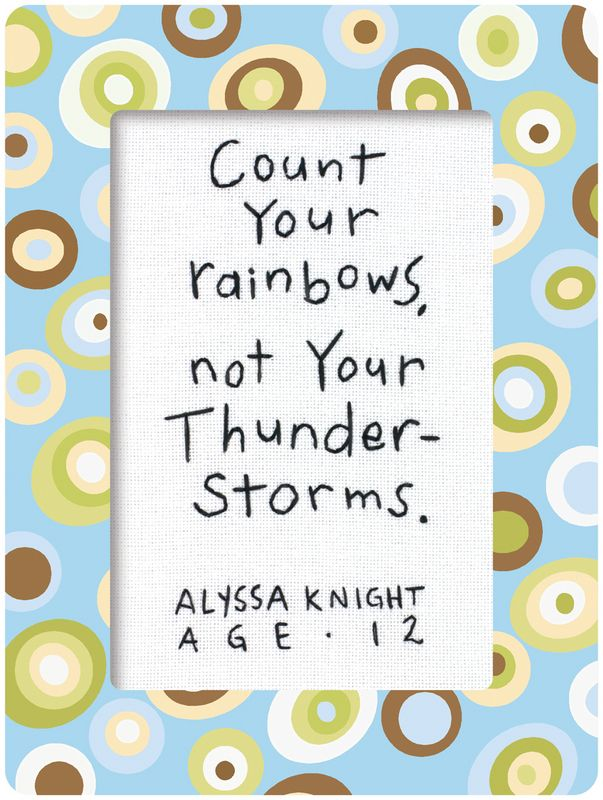
What does this quote mean to you?  Talk about the ‘rainbows’ in your life.  

What are you grateful for?  At a time when it is easy to focus on the ‘thunderstorms’ (challenges) tell me about the good things that are in your life that help you get through difficult times.


Personal Challenge  (optional) 

At the beginning of each week, please have a conversation with your child about setting an attainable goal for the week. On top of setting the goal, please have a conversation about how you and your child will know if the goal has been achieved. During some weeks, the goal may have a specific direction while other weeks the goal may be student driven.   

This week's challenge is focused on organization. Take a moment to walk around your house, noting the spaces that you feel would benefit from additional organization. Perhaps your cutlery drawer needs a little more attention, your bookshelf, or your sock drawer.  

Think about the following questions as you work towards achieving this goal this week: 
*Why did you select this particular space to organize? 
*Who would benefit from having this space organized? 
*How does it make you feel to have this space organized?